
Restaurant consistency is often explained as talent or effort. A “good night” gets credited to the team being sharp. A “bad night” gets blamed on people being off. In reality, most of what guests experience as consistency is designed long before service starts.
Consistency also isn’t the same as perfection. Restaurants are always adapting to small changes: ingredient condition, staffing, timing swings, and guest volume. The difference is that strong operations absorb those changes without letting the experience drift.
This is what Restaurant Operations means on FoodiJunction. It’s not management theory or motivational language. It’s the day-to-day mechanics that keep service stable, even when pressure is normal and time is tight.
What Consistency Really Means in Restaurant Service
In restaurant service, consistency means predictability. Guests don’t need every plate to be identical in a laboratory sense. They need the experience to feel steady: the same dish tastes the way it did last time, arrives in a reasonable window, and matches what the menu implies.
That predictability covers more than food quality. Timing is part of it, both within a table’s meal and across the room. Portioning is part of it, because value is experienced visually before it’s tasted. Communication is part of it, because guests feel delays more sharply when the room seems uncertain.
This is why consistency can exist even while kitchens adapt. Substitutions, pacing adjustments, and small changes in execution happen constantly. Guests still experience steadiness when the underlying system keeps decisions simple, standards clear, and problems contained before they spread.
The Systems That Protect Consistency During Service
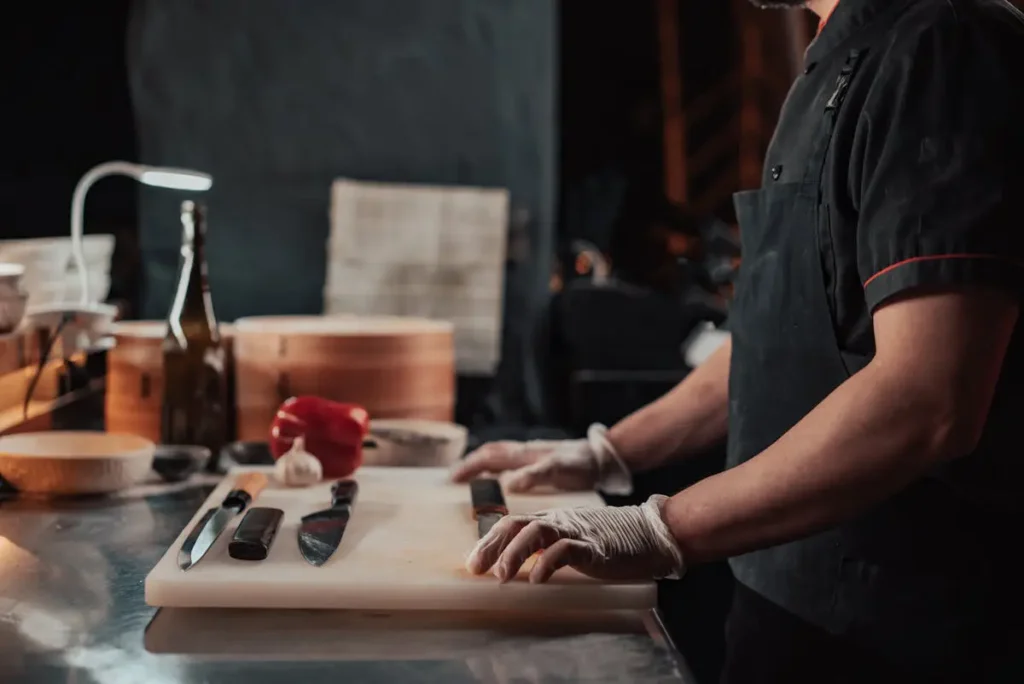
Consistency during service is protected by what happens before service and how work is arranged once tickets start moving. Prep is not just about having ingredients ready. It is about reducing variation. Portions are set, components are staged, and the station is organized so the cook reaches for the same items in the same order.
Stations function as small systems inside the larger system. Each one has a clear scope, a defined sequence of tasks, and a known rhythm with the stations around it, supported by kitchen systems designed for predictable flow. That structure limits the number of choices a cook has to make mid-service.
Standards also operate as decision shortcuts. They define what acceptable looks like before a plate is built, which reduces debate in the moment. A stable operation makes these boundaries visible so small issues can be corrected early, without turning into room-wide disruption.
Communication is the other layer that keeps the system from drifting. During service, information moves in patterns that are understood without explanation. When communication is consistent, the kitchen stays coordinated even under pressure, and problems are recognized while they are still localized.
Containment is where operations prove themselves. Every service produces friction: a delayed pickup, a missing component, a timing mismatch between stations. Consistency is protected when those problems stay small. Guests experience stability not because nothing goes wrong, but because disruptions are managed before they become the defining feature of the meal.
How Training and Habits Reinforce Consistency
Consistency holds over time because restaurants train for patterns, not for individual performance. A new cook doesn’t need a long explanation of every decision behind the menu. What matters is learning the repeatable sequence: how the station is set, how components are handled, what “ready” looks like, and how timing is coordinated with the rest of the line.
Repetition does most of the work. Standards become real when they are practiced under the same conditions every day, with the same expectations and the same corrections. Over time, the kitchen develops muscle memory around portioning, finishing, and pacing.
Daily reinforcement is what keeps habits intact. Small moments do more than formal training sessions: where items are returned, how components are labeled, what gets re-fired, how plates are checked before leaving the pass.
Shared defaults matter more than individual skill because service is coordinated work. A highly skilled person who works outside the defaults can introduce variation that others have to absorb. A moderately skilled person who follows the defaults tends to produce more predictable results.
New staff are absorbed through exposure to that existing rhythm. They step into a station that already has structure, language, and boundaries. Over time, the person adapts to the system, and the system remains stable even as the roster changes.
Where Consistency Breaks Down in Real Operations
Consistency tends to break down when demand stops matching the system’s capacity. Volume spikes are the most common example. A kitchen can be steady at a certain pace and still struggle when orders arrive in uneven waves. The issue is not that people forget how to cook. It is that timing dependencies tighten.
Staffing gaps create a similar strain, especially when they change the shape of the line. A station can be built around two sets of hands and fall out of rhythm when it becomes one. Turnover adds another layer because it changes how shared defaults are interpreted.
Menu complexity creep is another pressure point that builds slowly. A menu can start with clear structure and gradually accumulate variations, optional components, and edge-case requests that don’t fit the original flow, often because menu structure is no longer aligned with daily operations. Each addition expands the number of decisions required during service.
Communication overload tends to appear once multiple strains stack. When timing slips, staffing shifts, and menu variation rises at the same time, the message volume increases. Communication can stop functioning as coordination and start functioning as triage.
Why Consistency Is an Operational Outcome, Not a Personal Trait
Consistency is often described as something a restaurant “has” or “doesn’t have,” as if it lives inside individual talent. In practice, consistency is the result of design. It comes from decisions made about prep, station structure, standards, and communication long before the first ticket is fired.
This is also why heroics rarely produce repeatable results. A strong cook can carry a station through a rough stretch, but that kind of effort is temporary and hard to scale across a team. Systems, by contrast, spread competence.
Training and habits fit into this the same way. They don’t replace the system. They reinforce it. When the environment signals the same expectations every day, the kitchen builds shared rhythm and predictable decisions.
Understanding operations changes how success is judged. A smooth service is not a reflection of perfect staff or flawless nights. It is evidence that the restaurant has built a structure that absorbs strain, contains problems, and reduces avoidable variation.