
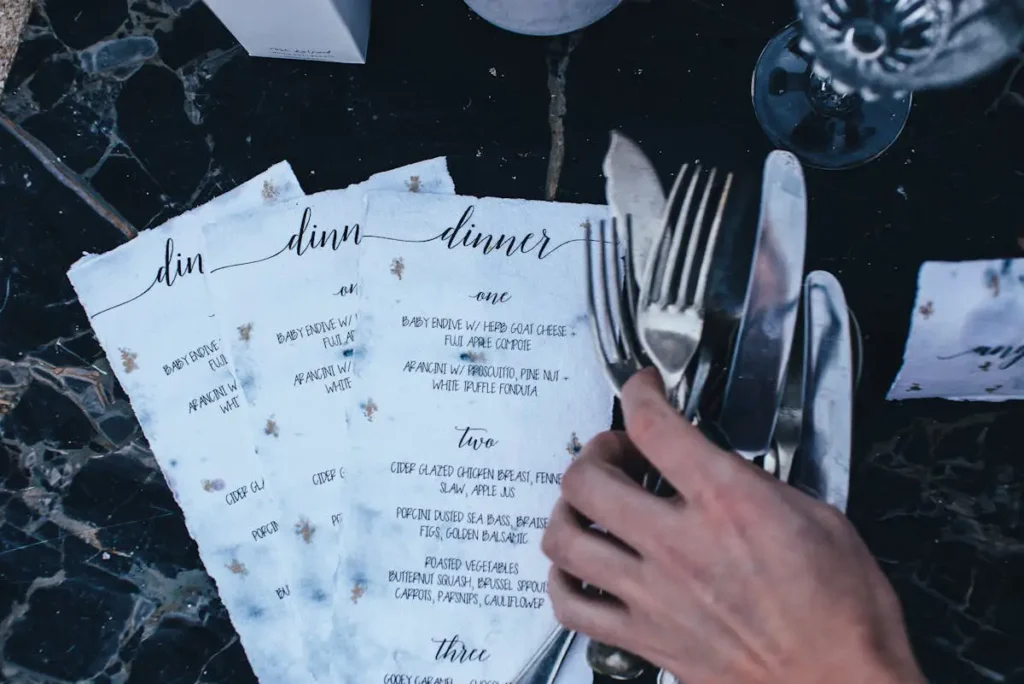
Menus are often treated as creative expressions, a place where a restaurant shows personality through dishes. In daily service, a menu functions more like infrastructure. It shapes what guests consider, what they expect, and how they move through a meal before the kitchen touches an ingredient.
A menu guides decisions under time pressure. Guests use it to choose quickly and feel confident in what they are ordering. The kitchen uses it to predict workload, coordinate timing, and keep production within a stable range. When the menu is clear, service tends to feel smoother because fewer questions, exceptions, and surprises need to be managed in real time.
This is what Menu Strategy means on FoodiJunction. It is not persuasion language or trend talk. It is an operational view of how menus control decisions, flow, and economics while protecting guest experience.
What a Menu Actually Does in a Restaurant
A menu acts as a decision filter. It limits the universe of possible orders to a set the restaurant can deliver repeatedly. That limitation is not a constraint placed on guests. It is a boundary that makes service predictable.
Menus also set expectations before anything is cooked. They signal what kind of meal this is, how it will be paced, and what a guest can reasonably assume about portioning and timing. The structure of the menu creates a mental model, and satisfaction often depends on whether the experience matches it.
Operationally, a menu controls complexity and flow. It determines which stations are busiest, which items require longer coordination, and where timing risk is concentrated. In that sense, a menu is not only about food. It is one of the main tools that keeps production within a range the restaurant can execute without constant improvisation.
How Menus Shape Kitchen Workflow and Capacity
Menus shape daily kitchen work by deciding what has to be prepared, held, and executed at speed. As item count grows, prep spreads across more components, more storage locations, and more timing windows. Even when individual dishes are simple, variety creates more moving parts.
During service, the menu determines how stations depend on each other. Some menu structures allow stations to operate in parallel, with clean handoffs and predictable pacing. Others require repeated coordination, where several stations must align at the same moment to finish a single order.
Bottlenecks often come from concentration rather than complexity. A menu can overload one part of the line by routing many items through the same stage, even if the dishes look different on paper. That station becomes the pace setter for the whole kitchen, shaping daily service operations.
A narrower set of options can increase reliability because repetition strengthens the system. Prep becomes more consistent because the same components appear across multiple orders. Stations learn the same sequences through constant use.
How Menus Shape Guest Expectations and Decision Flow
A menu shapes guest experience before food arrives by setting the structure of the decision. Guests rarely approach ordering as an open-ended exploration. They look for signals about what kind of meal this is and what choices are reasonable. Clear sections and consistent descriptions reduce the time it takes to decide because the menu offers an internal map.
Clarity reduces friction because it limits doubt. When items are described in a way that matches what guests can recognize, fewer questions need to be solved at the table. The menu communicates what a guest needs in order to choose with confidence: what the dish is, how it is positioned in the meal, and what expectations it sets around portion and pacing.
Large menus can slow decision flow for a different reason. More options can create more comparison, which increases time spent rereading and second-guessing. Even if the kitchen can execute the range, the guest experience can feel heavier because the act of choosing becomes work.
Expectation mismatch is where menu structure becomes most visible. Guests form a picture of what will happen based on how the menu frames the meal. When the pacing, portioning, or style of the food doesn’t match that picture, satisfaction can drop even if the dish is well made.
How Menu Structure Influences Profit Without Feeling Transactional
Menu structure influences profit mostly through predictability. When the menu creates stable patterns in what guests order, the restaurant can plan purchasing with fewer surprises. Inventory becomes easier to manage because demand clusters around a known set of components.
Repetition also reduces waste in quiet, cumulative ways. When the same ingredients and prep components appear across multiple dishes, they turn over more reliably. Waste isn’t only food that gets thrown away. It is also time spent producing items that never make it onto a plate, or holding components that lose value as they wait.
Labor efficiency follows the same logic. A stable menu structure allows stations to work in repeatable sequences with fewer exceptions. Prep becomes easier to schedule because tasks recur in familiar cycles. During service, cooks spend less time switching between unrelated processes.
Profit improves when variability is reduced because variability forces the operation to carry extra buffer. More buffer means more inventory risk, more prep uncertainty, more rework, and more communication load during service. The financial benefit is a side effect of the same stability that also supports faster service and more consistent guest experience.
Why Menu Strategy Is an Operational System, Not a Creative Exercise
Menus are often treated as an extension of personality, a place where a restaurant expresses itself through dishes. In daily service, the menu functions more like an operating boundary. It defines what the kitchen is built to deliver, what the dining room can promise, and what guests can reasonably expect.
A menu succeeds when it reduces friction on both sides of the experience. Guests feel that reduction as clarity, confidence, and pacing that makes the meal easy to move through. The kitchen feels it as workload that stays within a stable range, timing that can be coordinated across stations, and fewer exceptions that force mid-service improvisation.
Profit follows that steadiness as a side effect. When the menu creates predictable demand and repeatable work, purchasing becomes more stable, waste becomes easier to control, and labor becomes less fragmented.
Seeing menu strategy as an operational system changes how restaurants are judged. A good menu is not simply an interesting collection of dishes. It is a structure that makes the experience repeatable under pressure.